The Moon Swallows Venus
14 September 2026 · 6 min read
(Lunar Occultation of Venus)
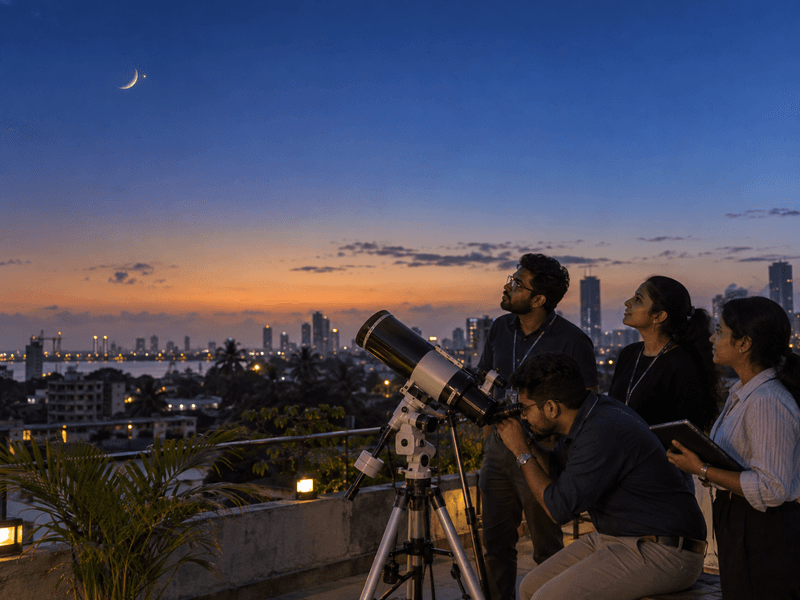
A special celestial event for Sri Lankan sky-watchers!
On September 14, 2026, all of you astronomy enthusiasts will have the opportunity to observe a truly special and extremely rare astronomical phenomenon. On that day, the Moon will pass in front of the planet Venus and completely cover it. This is known as a Lunar Occultation of Venus.
This is a wonderful lesson about the apparent (visual) angle and size of celestial bodies. The secret here is not size, but distance. The planet Venus, which has a diameter of about 12,000 km and lies about 69 million km away from Earth, will be completely blocked from our view by the Moon, which has a diameter of only about 3,500 km. This is possible because the Moon is much closer to Earth, at a distance of about 384,000 km. Even though Venus is about 3.5 times larger than the Moon in actual size, in terms of apparent (visual) size, the Moon appears about 50 times larger than Venus.
Normally, when the Moon and Venus appear close to each other in the sky, this is called a conjunction — but what happens here is something different and special. For observers within the correct viewing zone, Venus will disappear completely behind the Moon and later reappear. In particular, because Venus passes behind the dark limb (the dark edge/region) of the Moon, it doesn't fade away gradually — instead, it can be seen vanishing from the sky within a very short span of time.

The length of time Venus remains hidden behind the Moon varies depending on the observer's location. This hidden period is typically around 70 minutes, though the exact duration differs by location. Afterward, Venus will reappear near the Moon's bright limb (bright edge). This is the most fascinating moment of the whole event. However, because of the brightness of the Moon's surface, observing the moment Venus reappears can be more difficult than observing the moment it disappears.
The overall global time window for the September 14, 2026 occultation of Venus is approximately 09:26–13:42 UTC, and the full occultation is visible only from locations within this band/zone.
How rare is this event?
Although the Moon orbits the Earth every month, this kind of event is not common, because the plane of the Moon's orbit is tilted at a small angle relative to the orbital path of Venus and Earth. For an occultation to happen, the two objects must align precisely along the same line of sight. Also, the Moon's apparent position shifts slightly depending on where on Earth you're observing from. So, while Venus is completely occulted as seen from one part of the world, observers in another region may only see the Moon and Venus appearing close to each other.
In 2026, there will be three such lunar occultations of Venus, and the September 14 event is the second of these. The first occurred on June 17, and the third is scheduled for November 7. The September 14 event will be visible to people across a large area, including parts of Europe, Africa, and Asia, and Sri Lanka falls within this occultation zone. This means observers in Sri Lanka will have the opportunity to watch Venus disappear behind the Moon and later reappear.

Can it be observed with the naked eye?
Yes — since both the Moon and Venus are visible to the naked eye, this event can be observed without any equipment.
The event begins in the western evening sky on September 14. Venus will start disappearing behind the Moon at around 5:30 PM, though at that time it will be somewhat difficult to locate Venus properly, since daylight will still be present. Venus will remain hidden behind the Moon for no less than 1 hour and 15 minutes, and it will begin reappearing near the Moon's bright limb at around 6:45 PM. At that point, it can be observed easily.
How can it be observed with a telescope?
If you have a telescope, this event can be observed even at a minimum magnification of around 30x. Through the telescope, you'll be able to see the Moon's phase as well as the corresponding phase of Venus. Venus, currently shining at an apparent magnitude of about –4.7, will show its phase very clearly through a telescope during these days. The Moon will appear as a very thin waxing crescent, only about 12% illuminated.
With that, the phenomenon will look like a little "baby crescent moon" slipping past its "mother Moon," making for a truly beautiful sight. If you manage to capture a photo, please share it as a comment!

Safety Instructions
Since this event happens during the evening hours in Sri Lanka, you must observe it very carefully. Because sunlight is still present, do not sweep your telescope randomly across the sky while trying to locate the start of the Venus occultation.
What are Occultation, Conjunction, and Transit?
Because these three celestial phenomena often seem similar to each other, many people define them incorrectly.
Occultation
This is the term used when one celestial object completely covers/blocks another. What happens here is that an object closer to us passes in front of another object that is farther away, temporarily blocking it from our view. In this case, the distance from Earth to Venus is about 69 million km, while the Moon is only about 384,000 km away from us. Because the Moon's apparent (angular) size in the sky is nearly 50 times larger than Venus's apparent size, the Moon — which appears vastly larger than Venus — is able to completely cover the much more distant planet Venus. Similar events, where the Moon "swallowed" Venus, have previously been observed from various parts of the world on December 7, 2015, and in 2020, 2021, and 2023.
Conjunction
A conjunction is when two celestial objects appear very close to each other in the sky, as seen from Earth. In some cases, the two objects may even appear as a single object, even though they are not actually close to each other in space. For example, on March 24, 2023, the Moon and Venus appeared very close together in the sky — this event is referred to as a planetary conjunction. However, observers in certain regions saw the Moon completely cover Venus, meaning that for those regions, what actually occurred was an occultation.
Transit
A transit is another type of celestial alignment. Here, a smaller object passes in front of a larger one. Because this slightly reduces the brightness of the larger object, this phenomenon is used to detect exoplanets. The most recent transits of Venus occurred on June 8, 2004, and June 5, 2012. During those events, Venus appeared as a small black dot moving across the disk of the Sun. The next such transit will not be visible again until the year 2117.